|
| |
|

| ||||||||||||||||||||||||||||||||||
|
|
|
||||||||||||||||||||||||||||||||
|
To top this off, a March, 2001 survey of Americans by Chinese American leadership group Committee of 100 reveals that perceptions of Asian Americans have hit a low. Related links: Japanese American Citizens League AsianWeek article by Sam Chu Lin Committee of 100 Survey Pearl Harbor: Exclusive Interview with Cary-Hiroyuki Tagawa Pearl Harbor: Exclusive Interview with Ben Affleck AC Team's
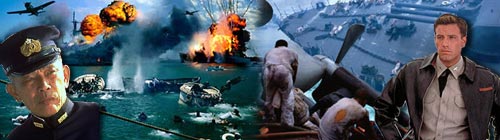
Solange Castro Belcher Reviews After seeing the movie, Pearl Harbor, I realize I can no longer live in my bubble of denial. The truth must be faced. Yes, we are living in a Republican administration. Pearl Harbor, Jerry Bruckheimer's latest adrenaline-pumping action-war film reeks so strongly of military romanticism that one might suspect he struck a deal with President Bush to resurrect the belief that war is the ultimate test and proof of American heroism. This Memorial Day weekend release is drenched in lines like "there's nothing stronger than the heart of a volunteer." Pearl Harbor could pass for a military recruitment ad campaign. After all, Top Gun, Bruckheimer's other famous military film glorifying the life of pilots, came out in 1986, during the height of the Reagan Administration. Bruckheimer hammers the parallels between these two films; the two main characters of Pearl Harbor are also stunt-performing military pilots and both movies feature a character named Goose. However, putting aside the glorification of battle, the saccharine dialogue and the odd casting choices (are we supposed to take Dan Akroyd seriously as a military captain?), I hastily admit Pearl Harbor does prove entertaining - the kind of entertainment I experience on amusement park rides. Still, beneath my helpless attraction to the Hollywood blockbuster adrenaline-hype, my interest in the movie emerged from a genuine desire to understand that historical day. As with all historical movies, I had a hope upon venturing to the screening that this film might reveal something about the experience of living in this country in 1941, when America was something far different, I imagine, from what we know today. For whatever reason, American audiences have also awakened a desire to know and understand World War II, and what more profound event to revisit than the moment that began it. In this respect, without even trying, Pearl Harbor has moments of succeeding in creating an intriguing tension between the ostensible innocence of America, and the doomed tragedy that lay ahead. Just as we all know that the Titanic will sink, we know that these characters, whether we like them or not, will experience a horror unlike any thing they've seen before. However, despite the swinging fun-loving portrayal of innocence that Hollywood frequently gives pre-World War II America, the era was not exactly America's shining moment. As many know, it was also a time of blatant discrimination and racism against Japanese-Americans, many of whom lost their homes and businesses while placed in internment camps. Aware of the potential for criticism by audiences of these not-so-heroic aspects of American history, and oddly enough, dependent upon Japan as a foreign market, Bruckheimer, and director, Randall Wallace and writer, Michael Bay claim they made an effort to portray the Japanese as humanly and humbly as possible. While planning the attack, Admiral Yamamoto played by Mako, confesses that "a brilliant man would find a way to not fight the war," and at the beginning of the attack a Japanese pilot waves to children playing outside to go inside. However, despite these gestures of amicability, I couldn't help but cringe at the number of references during the second half of the movie to those "Jap suckers." Real military pilots may have indeed uttered those words. But must we put them in the mouths of actors who will grace poster after poster, and remain imprinted in the minds of our children as "heroes?" However, the least forgivable crime of the movie remains the utter absence of any Hawaiians in the entirety of the film. I think I saw one Hawaiian woman for the blink of an eye in the right hand corner of the bar scene. Did all native Hawaiians leave Hawaii in 1941? Actually, Asian Pacific Americans dominated the civilian population in Hawaii in 1941, as they do today. Instead, we are treated to droves of Caucasian women walking in front of heavenly Hawaiian sunsets and white children playing in lush gardens. Granted, the military base itself was most likely predominately white, but the message remains that Hawaii belongs to "white" America, not to it's native inhabitants. Pearl Harbor also manages to treat African-American men with the same patronizing manner exhibited last summer in movies such as The Legend of Bagger Vance and Duets. In both those films black men played spiritual saviors to white men seeking meaning to their entitled lives. In Pearl Harbor Cuba Gooding plays Doris 'Dorie' Miller, a black man who aches to use weapons to fight but has been relegated by the American Navy to remain a cook. Still, when his Captain (who presumably assigned him to his duty as cook) dies in an explosion, Dorie displays several solemn and tearful tributes to his dead captain. The utter absence of anger or emotion towards the racism that affected his life is downright bizarre, if not confusing. For reasons I'd rather not know, Hollywood consistently exhibits a perpetual need for approval from African-American men in the story development of their African-American characters. And for my final complaint, Pearl Harbor seemed to pay the least attention to the men who deserved the most. Besides Dorie, Bay developed no story around the young soldiers who were on the ships, notably the U.S.S. Arizona. We watch them swimming underneath the water to escape bullets, or remaining trapped beneath the U.S.S. Arizona, but we are left with little sense of their experience of Pearl Harbor. However, John Schwartzman beautifully shot Hawaii's beaches and the tense battle scenes remain, as always, exciting. At the very least, Pearl Harbor reawakened my drive to plan my next vacation to Hawaii and a latent interest in learning more about the history of our country and that fateful day. Copyright
2001 Solange Castro Belcher for AsianConnections.com AC Team's Solange Castro Belcher moved to Hollywood to pursue a career as a stand-up comic after graduating from Yale University with a degree in English. Today she has turned her pursuits from comedy to film reviewing and screenwriting. Solange is managing editor at University of California at Los Angeles' groundbreaking Teaching to Change LA, an online journal for teachers, students and parents in the Los Angeles schools. In addition to her film reviews for AsianConnections.com and AC's Hollywood Web site StudioLA.com, she is a film reviewer for the Santa Monica Film Festival (smff.com). Email: solange@asianconnections.com
|
||||||||||||||||||||||||||||||||||
|
| ||||||||||||||||||||||||||||||||||